
Anti-Glare Window Film for Homes and Offices in Singapore
Professional window film solutions and onsite product demonstrations for Singapore properties.
Request a Free Consultation
Glare is more than an inconvenience. Strong daylight reflecting from computer screens, televisions, glossy surfaces and glass partitions can make it difficult to work, watch a screen or use a room comfortably. In Singapore, where bright tropical daylight can be intense throughout the year, glare often becomes a daily problem in west-facing homes, offices, meeting rooms and reception areas. Anti-glare window film helps reduce the amount of visible light entering through the glass, which can improve visual comfort while also providing solar-heat and UV-control benefits depending on the film selected.
Solar Heroes supplies and installs architectural window films with different levels of visible light transmission, reflectivity and total solar energy rejection. The right anti-glare solution is not simply the darkest product. It should reduce excessive brightness enough to improve screen visibility without making the room unnecessarily dim or forcing occupants to rely on artificial lighting all day.
What Causes Window Glare?
Glare occurs when the eye has to cope with excessive brightness or strong contrast. A computer monitor may be comfortable in a softly lit room but difficult to view when a bright window sits directly behind it or reflects across the screen. A television can show distracting reflections when sunlight strikes the display. Even without a screen, an intensely bright window can cause visual discomfort because the surrounding room is much darker.
The problem is influenced by window orientation, time of day, screen position, surface finishes and the amount of visible light transmitted by the glass. Direct afternoon sun can create acute glare, while an overcast sky can still produce high background brightness across large windows.
Window film works by reducing the amount of visible light transmitted and, depending on the product, changing reflectivity and solar-energy performance. It does not eliminate the need for good room layout, but it can make the daylight level easier to manage.
Where Anti-Glare Film Is Most Useful
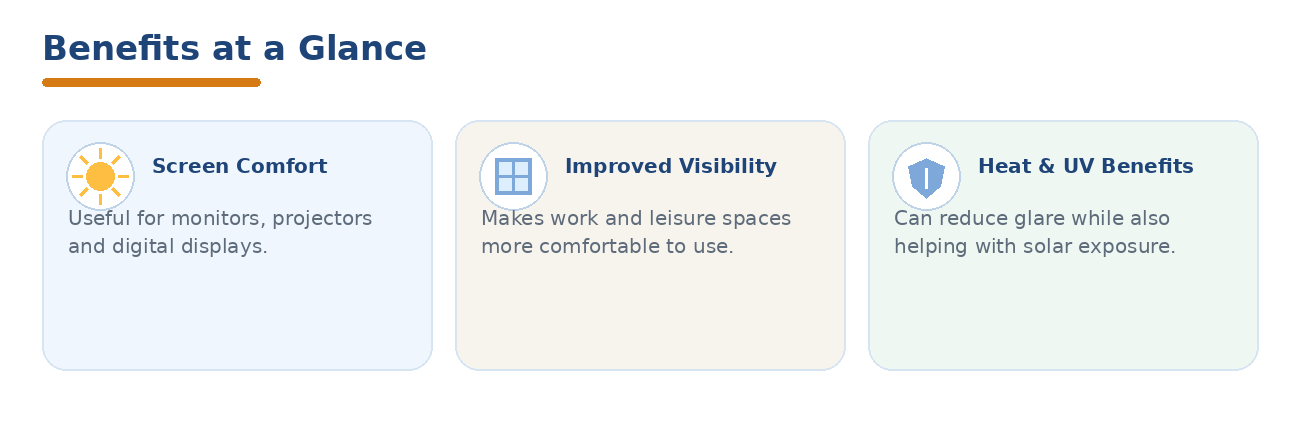
Anti-glare film can be helpful wherever window brightness interferes with how a space is used. In homes, common problem areas include living rooms with televisions opposite large windows, study rooms, work-from-home desks, gaming setups and bedrooms with low-angle sunlight. In offices, glare often affects open-plan workstations, meeting-room displays, reception desks and glass-fronted executive rooms.
The best candidates are spaces where the discomfort clearly follows daylight conditions. If a monitor is difficult to view only from mid-afternoon until sunset, the window is likely contributing. If the screen is uncomfortable at all hours, brightness settings, monitor type, room lighting or ergonomics may also need attention.
A site assessment helps separate glare caused by direct sunlight from glare caused by reflections within the room. That distinction prevents over-tinting windows when a change in screen position or a small blind could solve part of the problem more effectively.
How VLT Affects Glare
Visible Light Transmittance is one of the most relevant specifications for glare control. A lower VLT means less visible light passes through the film-and-glass system, so the room generally appears darker and glare is reduced more strongly. A higher VLT preserves more daylight but provides less visible-light reduction.
That creates a balancing decision. A 70% VLT film can retain a bright appearance and may be enough for moderate glare, while a 30% to 40% VLT film may be more appropriate for a severe west-facing screen problem. Very low VLT can be effective for brightness control but may be excessive for spaces that rely heavily on natural light.
The correct level depends on the room rather than a universal anti-glare number. Testing film samples during the period when glare is worst gives a far better indication than choosing from photographs or product names.
Anti-Glare Film for Home Offices
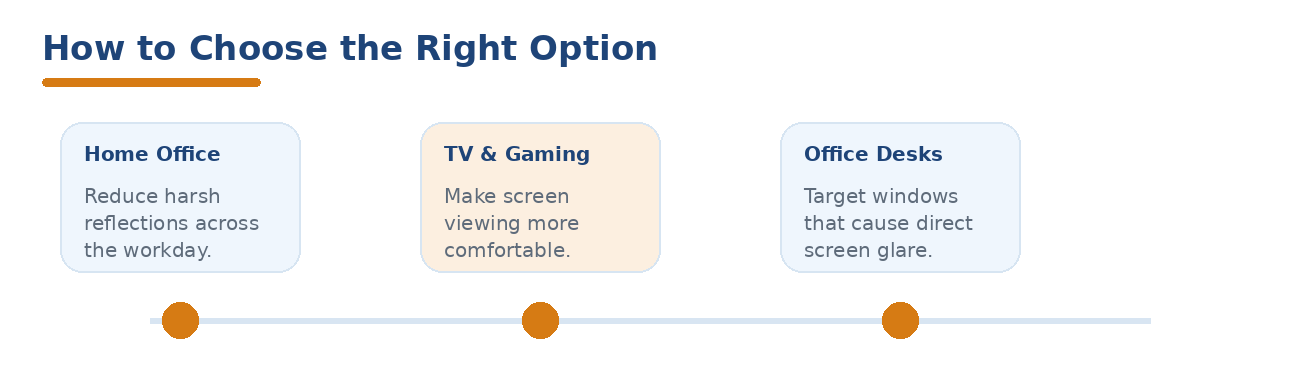
Home offices often combine limited floor space with large windows, leaving few choices for desk placement. If the screen faces the window, the user sees a bright background that can create visual strain. If the window is behind the user, reflections can appear on the display. Film can reduce the brightness difference and make the room easier to work in.
For a work-from-home space, the goal should be comfortable contrast rather than the darkest possible glass. A brighter nano-ceramic or multilayer film may be enough for moderate glare while preserving daylight. Stronger glare can justify a lower-VLT option, particularly where the room receives direct afternoon sun.
Film also works best as part of an ergonomic solution. Positioning the monitor perpendicular to the window, using adjustable blinds for peak sunlight and setting suitable screen brightness can complement the film and provide more flexible control throughout the day.
Office Window Film for Screen Comfort
In offices, glare is often a productivity and comfort issue because employees cannot simply move every workstation. Large glazed facades may affect dozens of monitors at once, and closing blinds throughout the day can remove natural light and outside views. Solar-control film offers a more permanent baseline reduction in brightness while allowing the space to remain visually open.
The best film for an office should be chosen with both employees and the building appearance in mind. Very dark or highly reflective glass may not suit every workplace or facade. Solar Heroes offers film options across a range of VLT and VLR values, making it possible to compare low-reflectivity ceramic or multilayer products with darker or more reflective alternatives.
For larger offices, a sample installation on a representative window can be valuable before treating an entire elevation. Staff can evaluate monitor visibility, room brightness and exterior views under normal working conditions.
Representative Solar Heroes Film Comparison
| Film | Construction | VLT | VLR | TSER | Best-fit consideration |
|---|---|---|---|---|---|
| Spectra 65 | Nano ceramic | 70% | 7% | 50% | High daylight, low reflectivity |
| Spectra 50 | Nano ceramic | 50% | 7% | 55% | Balanced daylight and solar control |
| Spectra 35 | Nano ceramic | 37% | 6% | 60% | Stronger glare and solar control |
| P9970 | Multilayer polyester | 69% | 8% | 55% | Clearer architectural appearance |
| P9940 | Multilayer polyester | 41% | 8% | 62% | Stronger premium solar control |
Specifications shown are based on current Solar Heroes published service-page data and should be checked against the latest technical data sheet before quotation or publication.
TV Rooms, Gaming Areas and Entertainment Spaces
Televisions and gaming displays often have glossy or semi-gloss screens that reflect bright windows. This can be especially distracting during films, sports or dark game scenes. Anti-glare window film reduces incoming visible light at the source, which can improve the perceived contrast of the display.
It is still important to remember that film is not a blackout treatment. If direct sun falls onto the screen itself, curtains or blinds may be needed during the brightest period. Likewise, a very bright room may benefit from a combination of moderate film and adjustable shading rather than a permanently dark film.
For living rooms where the family values daytime brightness, the best compromise is often a film that meaningfully reduces visible light and solar heat without changing the character of the room. An onsite sample comparison is particularly useful because display glare is highly subjective.
Glare, Heat and UV Can Be Addressed Together
A film selected for glare reduction can also provide solar-heat and ultraviolet control. This is useful because the same windows causing intense brightness are often receiving significant solar exposure. Comparing TSER alongside VLT allows the homeowner or facility manager to evaluate whether a film reduces overall solar energy as well as visible light.
Solar Heroes' current range includes Spectra nano-ceramic films, Black Pearl nano-carbon hybrid films, Ornyx metallised films and P99 multilayer films. The Spectra range, for example, provides different VLT levels while maintaining low published VLR values. P9970 and P9940 offer multilayer alternatives for owners seeking a clearer, lower-reflectivity architectural appearance.
No single percentage tells the whole story. A film with high infrared rejection at one wavelength may still have different total solar performance from another film. For comfort decisions, VLT, VLR and TSER should be evaluated together.
When Blinds or Curtains Are Still Useful
Window film provides continuous passive control, but it cannot adapt from hour to hour. Blinds and curtains remain valuable because they can be closed only when glare becomes severe or when night privacy is required. In some spaces, combining a moderate film with adjustable shading gives a better result than selecting a very dark permanent tint.
For example, an office may use a higher-VLT film to reduce everyday brightness and heat, then use roller blinds for a short period when direct sun strikes monitors. A home entertainment room may use film throughout the day and curtains for afternoon movie viewing.
This balanced approach also reduces the risk of making a room unnecessarily dark during cloudy conditions. A professional recommendation should acknowledge when another window treatment still has a role rather than presenting film as the only possible solution.
Installation and Film Care
Anti-glare film is installed in the same professional manner as other architectural window films. The glass is inspected, measured and cleaned thoroughly before the film is applied and trimmed. Any existing film may need to be removed first.
Temporary haze or small moisture pockets can remain during curing. The film should not be cleaned until the installer advises that it has cured sufficiently. Afterwards, soft non-abrasive cloths and suitable cleaners should be used. Abrasive pads, blades and harsh tools can damage the surface.
For offices, installation can often be planned by zone or outside the busiest periods to minimise disruption. The final schedule depends on glass area, access and site requirements.
Frequently Asked Questions
Does anti-glare film remove all screen reflections?
No. It reduces the visible light entering through the glass, but screen position, direct sun and interior reflections can still affect glare.
Is darker film always better for glare?
Darker film usually reduces visible light more strongly, but it can also make the room unnecessarily dim. The best VLT balances glare control with daylight.
Can I use anti-glare film in a home office?
Yes. It can be useful where a bright window causes screen glare, particularly when desk repositioning alone is not practical.
Will anti-glare film also reduce heat?
Many solar-control films reduce both visible glare and total solar energy, but the amount depends on the specific film. Compare TSER as well as VLT.
Can it help with TV reflections?
Yes, especially when the reflection comes from a bright window. Direct sunlight on the display may still require curtains or blinds.
Will the room look mirrored?
Not necessarily. Reflectivity varies by film. Low-VLR ceramic and multilayer options are available for a more neutral appearance.
Can offices test a film before a full installation?
A representative sample or demonstration is a useful way to evaluate monitor visibility and room brightness before committing to a larger area.
Does film help with night privacy?
Some darker films reduce visibility, but reflective one-way privacy is not dependable at night. Use curtains or blinds where night privacy matters.
A Practical Next Step
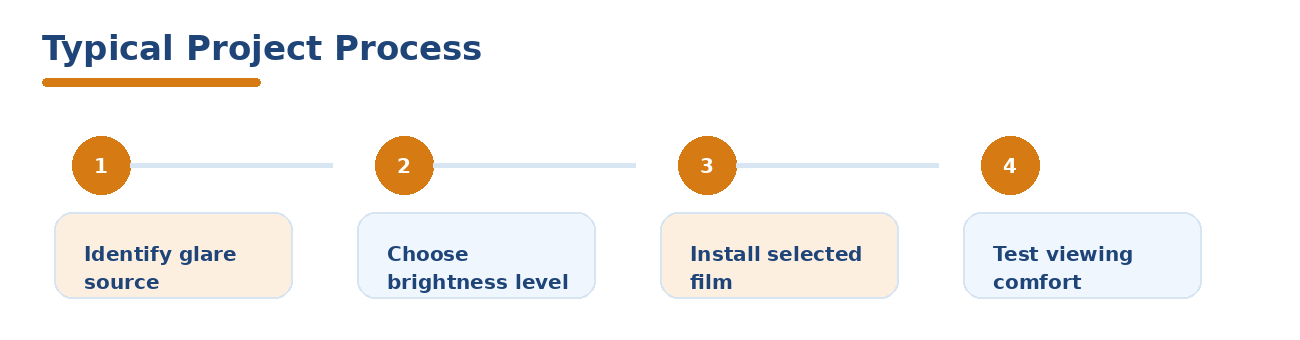
Good anti-glare window film should make a room easier to use, not simply make the glass darker. Solar Heroes can assess the direction of the problem light, compare film samples on the actual glazing and recommend a VLT and TSER range that fits the room. For a home office, television area, meeting room or large workplace, the best result comes from combining measurable film performance with the way people actually use the space.
Get a Window Film Recommendation
Contact Solar Heroes for a free consultation and onsite demonstration to compare suitable film options on your actual glass.
Request a Free Consultation