Window Film for Schools, Childcare Centres & Learning Spaces in Singapore
Professional window film solutions and onsite product demonstrations for Singapore properties.
Request a Free Consultation
Classrooms and learning spaces need useful daylight, comfortable temperatures and clear visibility of teaching materials and screens. Large windows can support a bright learning environment, but strong Singapore sunlight can also create glare, hot perimeter zones and prolonged ultraviolet exposure. Window film for schools, childcare centres, tuition centres and training rooms can help moderate solar heat and excessive brightness through existing glass while preserving natural light according to the needs of each space.
Solar Heroes supplies and installs architectural solar-control films with different visible-light, reflectivity and total solar-energy characteristics. In educational environments, the selection should be based on how the room is used rather than on the darkest available tint. Classrooms, nap rooms, staff offices, libraries and computer labs can have different priorities, so a room-by-room assessment is more useful than assuming one specification is ideal for the entire facility.
Why Learning Spaces Need Balanced Daylight
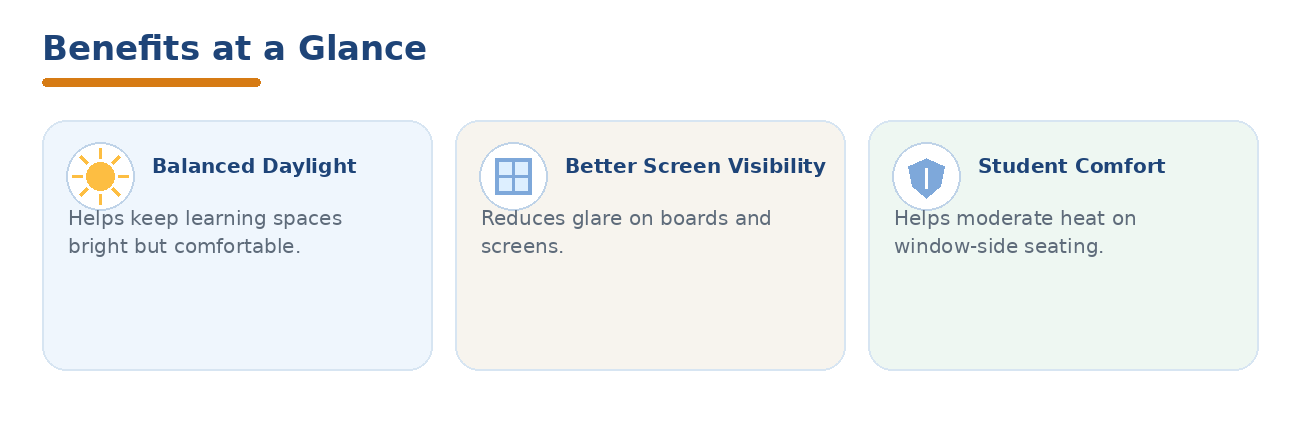
Natural light can make classrooms feel open and welcoming, but excessive brightness can create discomfort and reduce the visibility of boards, projectors and screens. The objective of window film is therefore not to eliminate daylight. It is to reduce the portion that causes glare and solar heat while keeping the room appropriately bright.
Visible Light Transmittance, or VLT, helps describe how much visible light passes through the filmed glass. Higher-VLT films preserve more daylight. Lower-VLT films provide stronger visible-light reduction and may be appropriate for rooms with severe glare.
A school should evaluate the film under normal teaching conditions. A room that looks pleasantly bright when empty may behave differently once screens, whiteboards and seating positions are considered. Sample testing during actual class hours can help staff choose a level that supports both visibility and comfort.
Reducing Glare on Interactive Boards and Screens
Digital teaching has increased the number of screens used in classrooms. Interactive panels, projectors, tablets and computer monitors can all become difficult to view when a bright window creates strong contrast or reflections.
Window film can reduce incoming visible light and improve screen comfort, but it should be combined with good room layout. Positioning screens away from direct reflections and using adjustable blinds for short periods of intense sun can provide additional control.
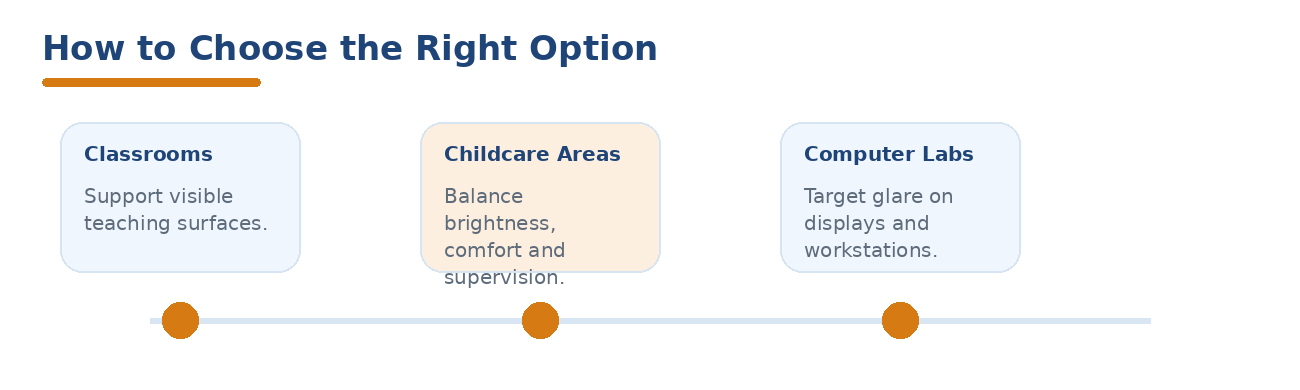
The film should not be so dark that teachers need artificial lighting throughout the day. A moderate VLT may be more appropriate for a general classroom, while a lower VLT may suit a computer lab or media room with persistent glare. The right choice depends on orientation and the equipment used.
Solar Heat Near Classroom Windows
Students seated near sun-exposed glass can feel warmer than those in the centre of the room because direct solar radiation increases radiant heat. This creates uneven comfort even when the room is mechanically cooled.
Solar-control film reduces the amount of solar energy transmitted through the glass, which can help moderate the perimeter zone. TSER is a useful specification for comparing overall solar performance. A higher TSER generally indicates stronger total solar-energy rejection under the stated test conditions.
Actual room-temperature or energy changes depend on glass area, orientation, shading, occupancy, ventilation and air-conditioning, so schools should avoid expecting a fixed percentage improvement without site-specific measurement. The practical goal is a more even and usable learning environment.
Window Film for Childcare Centres
Childcare environments often include play areas, reading corners, nap rooms and activity spaces with different daylight requirements. A bright playroom may benefit from a high-VLT solar-control film, while a nap area may need more visible-light reduction or additional curtains.
Privacy can also matter for selected windows. Tinted or reflective films may reduce daytime visibility under suitable lighting conditions, but they should not be described as permanent one-way privacy. Frosted film can provide stronger visual obscurity where an outside view is not needed.
Any film used in a childcare setting should be professionally installed, compatible with the glazing and maintained with safe, non-abrasive cleaning practices. Film selection should also fit the centre's operational and building-management requirements.
Schools, Tuition Centres and Training Rooms
Different education facilities have different patterns of use. Schools may have long teaching days and many rooms across multiple orientations. Tuition centres can occupy commercial units with large shopfront glass. Training rooms may rely heavily on presentation screens and need stronger glare control.
A zoned approach can therefore be more efficient. South- or shaded rooms may need little treatment, while west-facing classrooms may need stronger solar and glare control. Reception areas can use a brighter film to preserve an open appearance, and computer rooms can use a lower-VLT option if screen reflections are severe.
This room-by-room approach helps avoid unnecessary over-tinting and directs the budget to the glazing that creates the most discomfort.
Representative Solar Heroes Film Comparison
| Film | Construction | VLT | VLR | TSER | Best-fit consideration |
|---|---|---|---|---|---|
| Spectra 65 | Nano ceramic | 70% | 7% | 50% | High daylight, low reflectivity |
| Spectra 50 | Nano ceramic | 50% | 7% | 55% | Balanced daylight and solar control |
| Spectra 35 | Nano ceramic | 37% | 6% | 60% | Stronger glare and solar control |
| P9970 | Multilayer polyester | 69% | 8% | 55% | Clearer architectural appearance |
| P9940 | Multilayer polyester | 41% | 8% | 62% | Stronger premium solar control |
Specifications shown are based on current Solar Heroes published service-page data and should be checked against the latest technical data sheet before quotation or publication.
UV Reduction in Learning Environments
Ultraviolet radiation contributes to fading of books, posters, fabrics, flooring and furnishings. It is also one component of solar exposure through glass. Solar-control films can significantly reduce UV transmission, depending on the product.
Solar Heroes currently publishes 99.9% UV rejection for multiple films in its range, subject to the current technical documentation for the exact model. This can help reduce one contributor to fading, but visible light, heat, material chemistry and time also play important roles.
For libraries, display areas or spaces with sensitive materials, window film can be part of a broader protection strategy. Particularly valuable items may still require specialist conservation measures rather than relying on architectural film alone.
Choosing Film Without Making Classrooms Too Dark
Educational spaces generally benefit from daylight, so starting with a higher-VLT film can make sense where glare is moderate. Solar Heroes currently lists Spectra 65 at 70% VLT, 7% VLR and 50% TSER, and P9970 at 69% VLT, 8% VLR and 55% TSER. These options retain substantial visible light while providing published solar-control performance.
For stronger glare or afternoon heat, lower-VLT options can be considered. Spectra 35, for example, is currently listed with 37% VLT, 6% VLR and 60% TSER. The appearance is noticeably darker than a 70% VLT film, so it should be evaluated in the actual room.
There is no single 'school film' that fits every classroom. The best choice depends on orientation, window area, teaching equipment and the desired brightness level.
Reflectivity, Privacy and Exterior Appearance
Schools and childcare centres may occupy purpose-built campuses, shophouses, malls or office buildings. The external appearance requirements can therefore vary. A highly reflective film may suit some facades and conflict with landlord or building-management expectations in others.
VLR helps compare reflectivity. Lower-VLR ceramic and multilayer films can provide a more neutral appearance, while metallised films may be more reflective. Where privacy is needed, staff should understand the limitations of reflective one-way effects at night.
Facilities in managed buildings should check the applicable rules before installation, particularly if the film noticeably changes the facade. This is especially important for leased tuition centres and childcare centres in commercial properties.
Installation Planning Around Classes
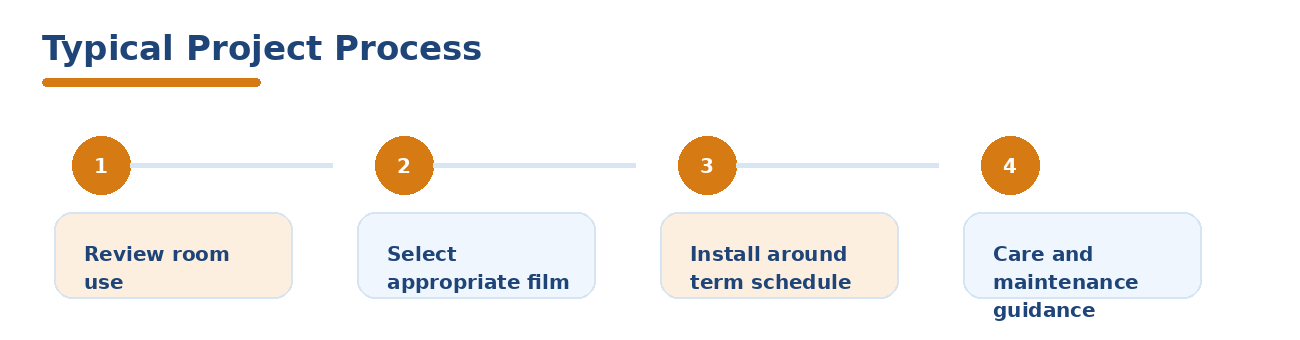
Educational facilities need installation to minimise disruption and maintain safe access. Work can often be scheduled during weekends, school breaks, after classes or by room. Desks, teaching equipment and movable furnishings near the windows should be cleared so installers can work safely.
The glass is cleaned thoroughly before film application. Temporary moisture or haze can remain during the curing period, and cleaning should wait until the installer confirms the film is ready. After curing, soft non-abrasive cloths and suitable cleaners should be used.
For larger campuses, a pilot room can be a useful first step. Teachers and facility managers can assess daylight, glare and thermal comfort before applying the chosen specification across similar classrooms.
How to Build a Practical Film Specification for a School
A useful school specification starts with a simple survey: which rooms face direct afternoon sun, which rooms have screen-glare complaints, which spaces require privacy, and which areas depend heavily on natural daylight? The glazing type should then be confirmed.
Suitable films can be shortlisted using VLT, VLR and TSER. Samples should be viewed on representative windows, and any building-management requirements should be checked. Where the facility has many different room types, the final specification can use two or three film levels instead of forcing one film everywhere.
Solar Heroes' range of nano-carbon hybrid, metallised, nano-ceramic and multilayer films allows this kind of tiered approach. The result should be a learning environment that remains bright enough for everyday use while reducing the windows' contribution to glare and solar heat.
Frequently Asked Questions
Will window film make classrooms too dark?
Not if the correct VLT is selected. Higher-VLT films preserve more daylight, while lower-VLT options are used where stronger glare control is needed.
Can film reduce glare on classroom screens?
Yes. Reducing visible-light intensity can improve screen visibility, although screen position and blinds may also be important.
Can it make window-side seats more comfortable?
Reducing solar energy through the glass can help moderate radiant heat near sun-exposed windows.
Is window film suitable for childcare centres?
It can be, provided the film is appropriate for the glazing, professionally installed and selected according to the room's daylight, privacy and comfort needs.
Does UV film stop all fading?
No. UV is only one contributor. Visible light, heat, material chemistry and time can also cause fading.
Can reflective film provide privacy at night?
Not reliably. Reflective privacy depends on lighting and can reverse when the inside is brighter than outside.
Can installation be done during school holidays?
Yes, scheduling during weekends, holidays or after classes is often practical, subject to project size and site access.
Should every classroom use the same film?
Not necessarily. Different orientations and room uses can justify different film specifications.
A Practical Next Step
The best educational window-film project starts with how each room is used. Solar Heroes can assess classroom orientation, glare, glass type and daylight requirements, demonstrate suitable film samples and build a practical specification for the facility. For schools, childcare centres, tuition centres and training rooms, the goal is a balanced learning environment: useful daylight, less glare, reduced solar heat through the glass and a film appearance that suits the building.
Get a Window Film Recommendation
Contact Solar Heroes for a free consultation and onsite demonstration to compare suitable film options on your actual glass.
Request a Free Consultation