Window Film for Restaurants, Cafes & F&B Spaces in Singapore
Professional window film solutions and onsite product demonstrations for Singapore properties.
Request a Free Consultation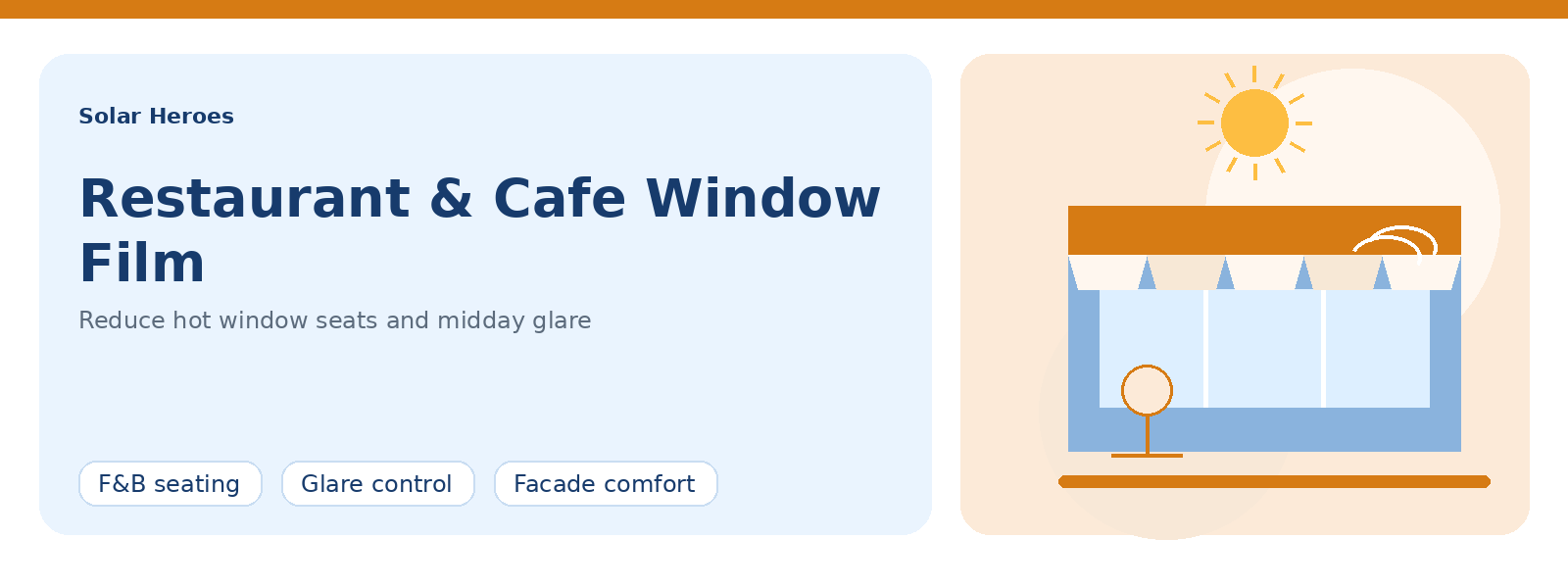
Large windows help restaurants and cafes feel open, bright and connected to the street or surrounding view. They can also make the most attractive tables uncomfortable during sunny periods. Guests seated beside glass may experience radiant heat and glare even when the air-conditioning is running, while operators may keep blinds closed and lose the atmosphere that the glazing was meant to create. Window film for restaurants, cafes and other F&B spaces provides a passive way to reduce solar heat and excessive brightness through the glass while preserving useful natural light.
Solar Heroes installs architectural solar-control films for commercial properties in Singapore, with options ranging from brighter low-reflectivity films to darker or more reflective products for stronger glare control. In an F&B environment, film selection should consider customer comfort, view quality, ambience, digital screens, operating hours, facade appearance and building management requirements. The right film supports the dining experience rather than making the space feel dim or disconnected.
When the Best Window Seats Become the Hottest Seats
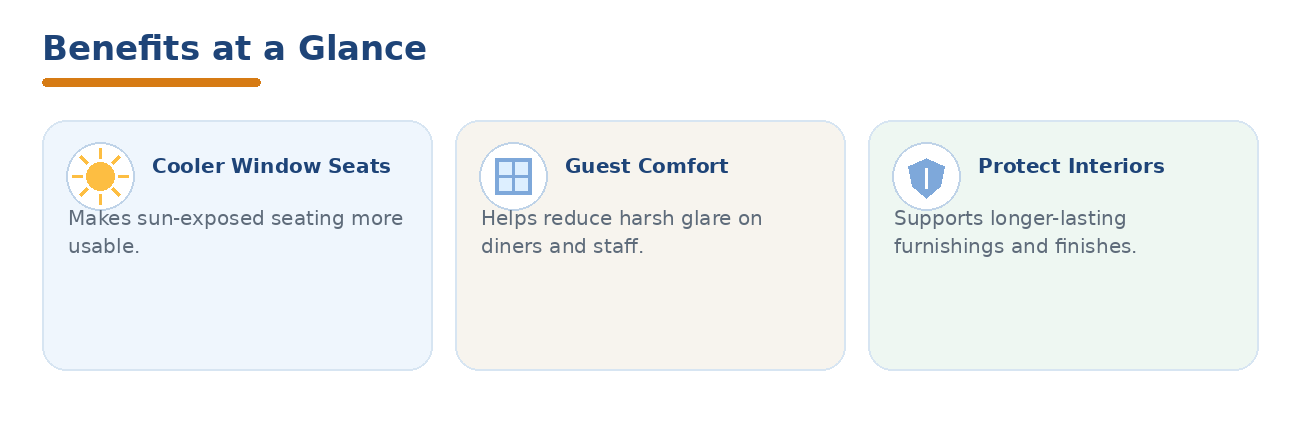
Restaurants often place premium tables along windows because customers enjoy daylight and views. During strong sun, however, those seats can become the least comfortable in the room. Direct solar radiation warms surfaces and people near the glass, creating a radiant effect that is not fully reflected by the thermostat reading.
If customers repeatedly ask to move away from the window at certain times, the problem may be solar gain rather than inadequate air-conditioning. Window film can reduce the amount of solar energy transmitted through the glazing and help make the perimeter zone more usable.
This can be particularly relevant for west-facing restaurants that receive low-angle afternoon sun, cafes with floor-to-ceiling facades and dining spaces in buildings with little external shading. A site assessment should be carried out during or near the problem period whenever possible.
Reducing Solar Heat Without Losing the View
A common concern for F&B operators is that window film will make the restaurant dark or obstruct a valuable view. High-VLT, low-reflectivity films can provide solar control while preserving a relatively bright and neutral appearance.
Solar Heroes currently lists Spectra 65 with 70% VLT, 7% VLR and 50% TSER, and P9970 with 69% VLT, 8% VLR and 55% TSER. These options can be considered where maintaining daylight and transparency is a priority. Stronger exposure may require lower-VLT alternatives such as Spectra 35 or P9940, which should be tested for ambience before a full installation.
The right choice depends on the concept. A bright brunch cafe may prioritise natural light, while a bar or evening-led restaurant may be comfortable with a darker daytime appearance if it controls severe afternoon heat and glare.
Glare Control for Diners and Staff
Glare can affect both customers and employees. Diners may struggle to look toward a bright window, while staff using POS terminals or tablets can have difficulty reading screens. Digital menu boards can also appear washed out when strong daylight hits the display.
Lowering visible-light transmission can reduce this contrast. The key is to reduce excessive brightness without flattening the atmosphere of the room. Very dark film may be unnecessary if the glare occurs for only a short period, in which case a moderate film combined with blinds can provide more flexibility.
Screen position should also be considered. Window film is more effective when it is part of a broader layout strategy rather than expected to compensate for a screen placed directly opposite intense sunlight.
Cafe and Bakery Frontages
Cafes and bakeries often rely on transparent storefronts to display activity, products and seating. A strongly mirrored facade may not suit a brand that wants an open and inviting street presence. Low-reflectivity ceramic or multilayer films can therefore be attractive because they provide solar control while keeping the exterior appearance more neutral.
Food displays near windows may also receive prolonged light exposure. Film that reduces UV transmission can help reduce one contributor to fading or material degradation, but it should not be treated as a food-safety control or a substitute for proper temperature management. Products that require controlled storage should remain in appropriate refrigerated or protected conditions.
The film should be selected to support the customer experience, visual merchandising and operational requirements rather than based on a single performance claim.
Restaurants With Full-Height Glass
Full-height glazing can create a dramatic dining environment, but the total exposed area can admit substantial solar energy. This is common in waterfront restaurants, mall units, hotel dining rooms and modern standalone venues.
For large glazed areas, the total solar energy rejected by the film becomes an important comparison metric. TSER should be considered alongside VLT and VLR so operators understand the trade-off between solar performance, brightness and reflectivity.
A test panel can be especially useful. Management can observe the sample during lunch, afternoon and evening service to see how the film affects views, interior lighting and exterior appearance. This is more reliable than making a decision from a small handheld swatch.
Representative Solar Heroes Film Comparison
| Film | Construction | VLT | VLR | TSER | Best-fit consideration |
|---|---|---|---|---|---|
| Spectra 65 | Nano ceramic | 70% | 7% | 50% | High daylight, low reflectivity |
| Spectra 50 | Nano ceramic | 50% | 7% | 55% | Balanced daylight and solar control |
| Spectra 35 | Nano ceramic | 37% | 6% | 60% | Stronger glare and solar control |
| P9970 | Multilayer polyester | 69% | 8% | 55% | Clearer architectural appearance |
| P9940 | Multilayer polyester | 41% | 8% | 62% | Stronger premium solar control |
Specifications shown are based on current Solar Heroes published service-page data and should be checked against the latest technical data sheet before quotation or publication.

Protecting Interior Finishes and Furnishings
Sunlight can affect upholstery, timber finishes, artworks, menus and decorative elements over time. Ultraviolet radiation is an important contributor to fading, but visible light, heat and material chemistry also matter.
Solar-control film can reduce UV transmission and, depending on the model, reduce part of the visible and solar-energy load reaching the interior. Solar Heroes currently publishes 99.9% UV rejection for multiple products in its range, subject to verification against the current technical data for the exact film selected.
Operators with valuable artworks, wine displays or highly light-sensitive interior materials may still need additional specialist controls. Film should be presented as one layer of protection rather than a guarantee against fading or degradation.
Window Film and Air-Conditioning Load
Reducing solar energy through glass can lower one component of a restaurant's cooling load. That can be useful in F&B spaces where doors open frequently, occupancy changes quickly and kitchen heat already adds to the cooling demand.
Actual energy savings cannot be predicted responsibly from film alone without considering glass area, orientation, air-conditioning efficiency, thermostat settings, occupancy, equipment, kitchen operation and building envelope. Claims of a guaranteed percentage reduction should therefore be avoided unless supported by project-specific measurement.
For most operators, the immediate benefit to evaluate is comfort in the perimeter seating zone. If previously hot tables become more usable during peak sun, the operational value can be meaningful even before any energy analysis is performed.
Installation Around Service Hours
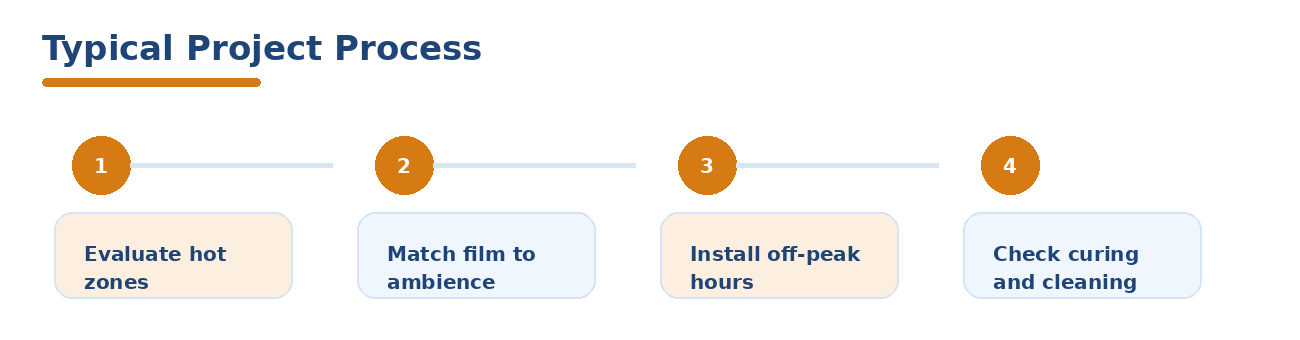
F&B businesses need installation to be planned carefully around operating hours, hygiene and customer access. Work may be scheduled before opening, after closing or during a closed day depending on the size of the project and building restrictions. Tables, decorative items and equipment near the glass should be moved or protected.
The installer cleans the glass thoroughly before applying and trimming the film. Temporary moisture or haze may remain while the film cures. Cleaning should wait until the installer confirms that the film is ready.
Mall and hotel venues should check access permits, contractor rules and after-hours working requirements in advance. The film's external appearance may also need to meet landlord or building-management guidelines.
Selecting the Right Film for an F&B Concept
A bright daytime cafe, premium restaurant, quick-service outlet and cocktail bar can require very different window treatments. VLT helps determine how much daylight is retained, VLR helps indicate visible reflectivity and TSER helps compare total solar performance.
Nano-ceramic and multilayer films can suit venues that want low reflectivity and a more neutral facade. Metallised films can provide effective solar control where a more reflective appearance is acceptable. Hybrid films offer another balance of performance and aesthetics.
Solar Heroes can demonstrate multiple film samples so the operator can judge them within the actual interior design. The final choice should feel like part of the space, not an afterthought added to the glass.
Frequently Asked Questions
Can window film make window-side tables more comfortable?
It can reduce the solar energy entering through the glass, which can improve comfort near sun-exposed windows.
Will film make my restaurant too dark?
Not necessarily. Higher-VLT options preserve more daylight, while lower-VLT films provide stronger brightness and glare reduction.
Can film help with POS screen glare?
Yes. Reducing visible-light intensity can improve screen contrast, although screen position and blinds may also help.
Can it reduce fading of furnishings?
Film can reduce UV exposure and other solar factors depending on the product, but it cannot guarantee that furnishings will never fade.
Can installation happen outside service hours?
Often yes, subject to building access and project size.
Does solar film guarantee lower electricity bills?
No. It can reduce solar heat through glass, but actual energy use depends on many building and operational factors.
Which film is best for a cafe that wants a clear storefront?
A higher-VLT, low-reflectivity ceramic or multilayer film may be suitable, but the exact choice should be tested on the actual glass.
Do mall restaurants need landlord approval?
Requirements vary. Check the lease, landlord and building-management rules before installing a film that changes facade appearance or requires contractor access.
A Practical Next Step
For F&B spaces, the best window film supports the experience customers are paying for. Solar Heroes can assess the sun-exposed seating areas, demonstrate samples and recommend a film that balances comfort, daylight, glare control and the restaurant's visual identity. A site visit during the problem hours is especially useful because it shows exactly how sunlight affects the space under real operating conditions.
Get a Window Film Recommendation
Contact Solar Heroes for a free consultation and onsite demonstration to compare suitable film options on your actual glass.
Request a Free Consultation