
Retail Shop & Storefront Window Film in Singapore
Professional window film solutions and onsite product demonstrations for Singapore properties.
Request a Free Consultation
A glass storefront attracts attention, displays products and brings natural light into a retail space, but the same glass can create uncomfortable heat, glare and prolonged solar exposure for merchandise. Customers sitting or browsing near the facade may feel warmer, screens can become difficult to view, and products close to the window can receive hours of ultraviolet and visible-light exposure. Retail shop window film gives businesses a way to improve the performance of existing glass while preserving the visibility that makes a storefront commercially valuable.
Solar Heroes supplies and installs architectural solar-control films for Singapore retail spaces, boutiques, salons, showrooms and service businesses. The right film should support the store's commercial priorities: keeping displays visible, maintaining a welcoming interior, reducing solar heat and glare, and selecting a facade appearance that fits the brand and building requirements. This is different from simply applying the darkest tint available.
Why Storefront Glass Creates a Unique Solar-Control Problem
Retail glass has to perform two jobs at the same time. It separates the air-conditioned interior from the outdoor environment, and it acts as a visual marketing surface that lets people see products, displays and activity inside the store. A film that blocks too much visible light can undermine that second function.
At the same time, untreated glazing can allow substantial solar energy into the front zone of the shop. Staff may avoid workstations near the glass, customers may move away from sunny seating or browsing areas, and air-conditioning may have to compensate for a concentrated solar load.
The best retail film therefore balances transparency and control. A store with high-value display merchandise may prioritise UV reduction and a clear appearance, while a west-facing street shop may need stronger heat and glare control. A showroom may care about colour neutrality because customers need to view products accurately.
Keeping Merchandise Visible While Reducing Solar Exposure
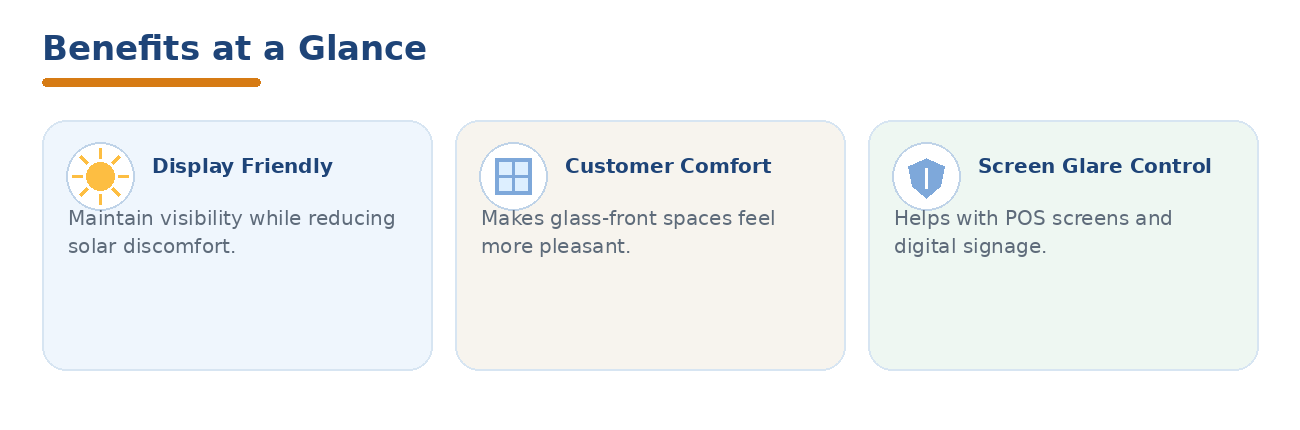
A common concern is whether film will make a storefront look closed or obscure displays. High-VLT films can preserve more visible light and maintain strong visibility through the glass while still providing measurable solar control.
Solar Heroes currently lists Spectra 65 at 70% VLT, 7% VLR and 50% TSER, and P9970 at 69% VLT, 8% VLR and 55% TSER. These brighter options can be useful where storefront transparency is a priority. Stronger sun exposure may justify lower-VLT products, but the effect on displays and interior brightness should be tested before installation.
Retailers should evaluate samples from both sides of the glass. A film that looks neutral from inside may appear more reflective from the pavement under bright daylight. Because the storefront is part of the brand, exterior appearance deserves the same attention as technical performance.
UV Reduction and Product Fading
Ultraviolet radiation is one contributor to fading and material degradation, but it is not the only one. Visible light, heat, material chemistry and exposure time also play a role. Retailers should therefore avoid assuming that UV film alone will make products fade-proof.
Solar Heroes currently publishes 99.9% UV rejection for multiple films in its range, subject to the current product data for the exact film chosen. Reducing UV transmission can be valuable for apparel, furnishings, packaging, artwork and other display items exposed to daylight, but highly sensitive merchandise may require additional measures such as changing display positions, rotating stock or using specialist lighting and conservation controls.
A well-selected solar film can still provide useful layered protection because it can reduce UV exposure while also reducing part of the solar heat and visible-light intensity reaching the display zone.
Customer Comfort Near the Glass
Retail floor plans often place display tables, browsing areas, waiting seats or consultation counters near the front windows. These areas are commercially important because they are visible and inviting, but direct sun can make them uncomfortable during certain hours.
Solar-control film can reduce the amount of solar energy transmitted through the glass, helping create a more consistent environment near the storefront. Actual energy savings or temperature changes vary according to glass area, orientation, building construction, occupancy and air-conditioning settings, so they should not be promised as fixed percentages without project-specific measurement.
For businesses, the practical objective is comfort. If customers can comfortably remain in the front zone of the shop rather than moving away from the glass, the display area becomes more usable throughout the day.
Glare Control for Digital Displays and POS Areas
Modern retail spaces often use digital menu boards, promotional screens, point-of-sale terminals and tablets. Strong daylight can wash out displays and create reflections that make screens hard to read. A lower-VLT solar film can reduce visible-light intensity and improve contrast.
The film should still be selected carefully because overly dark glazing can change the appearance of the shop. In some cases, a moderate film combined with repositioning a screen or adding local blinds is better than using a very dark storefront tint.
A site visit during the problem time is useful. Morning glare and afternoon glare may come from different directions, and a display that looks fine at 10 a.m. may become unreadable at 4 p.m. The film should be chosen based on the actual operating conditions.
Representative Solar Heroes Film Comparison
| Film | Construction | VLT | VLR | TSER | Best-fit consideration |
|---|---|---|---|---|---|
| Spectra 65 | Nano ceramic | 70% | 7% | 50% | High daylight, low reflectivity |
| Spectra 50 | Nano ceramic | 50% | 7% | 55% | Balanced daylight and solar control |
| Spectra 35 | Nano ceramic | 37% | 6% | 60% | Stronger glare and solar control |
| P9970 | Multilayer polyester | 69% | 8% | 55% | Clearer architectural appearance |
| P9940 | Multilayer polyester | 41% | 8% | 62% | Stronger premium solar control |
Specifications shown are based on current Solar Heroes published service-page data and should be checked against the latest technical data sheet before quotation or publication.
Boutiques, Salons, Showrooms and Service Businesses
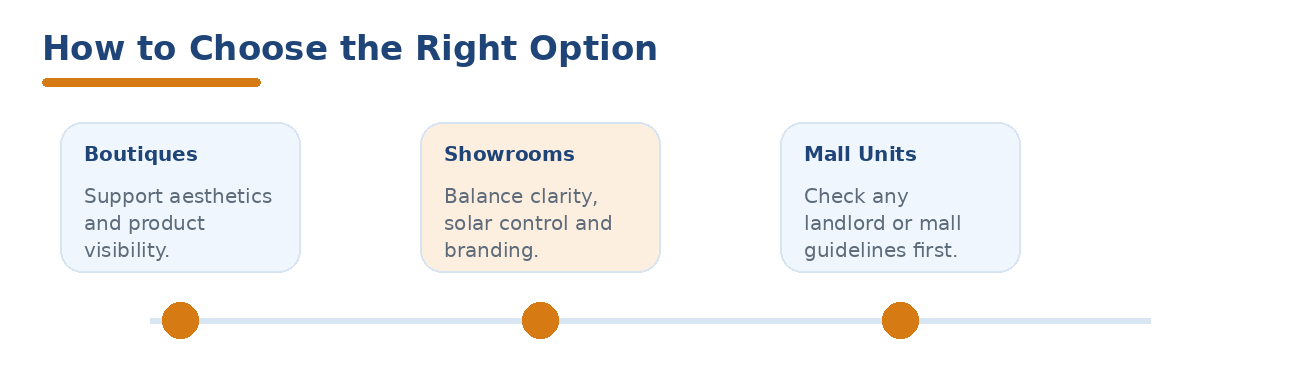
Different retail formats have different priorities. Fashion boutiques and furnishing stores may care strongly about display fading and colour presentation. Salons may want customer comfort near windows while keeping the interior bright and welcoming. Automotive or product showrooms often have very large glazed facades and require a film that does not distort the colour or perceived finish of merchandise.
Service businesses such as clinics, studios and consultancies may also use storefront glass but want more privacy. In those cases, solar control can be combined with selected frosted areas, graphics or other privacy treatments rather than tinting the entire facade heavily.
This is why retail film should be specified around the commercial use of the space. The right solution for a boutique is not automatically the right solution for a showroom or salon even if the glazing looks similar.
Choosing a Film That Fits the Brand
A storefront is part of the visual identity of a business. Highly reflective glass can create a sleek appearance for some brands, while others prefer a transparent, open look. Solar Heroes offers metallised, nano-ceramic, hybrid and multilayer options that can produce different combinations of reflectivity and brightness.
VLR is particularly useful for comparing visible reflectivity. Lower VLR generally produces a less mirror-like appearance, while higher VLR can create stronger exterior reflection in suitable lighting. VLT affects how much visible light passes through and therefore how open the shop appears. TSER helps assess overall solar performance.
The decision should be tested with real samples because surrounding buildings, pavement colour, interior lighting and sun angle all change how the glass looks from outside.
Installation Around Trading Hours
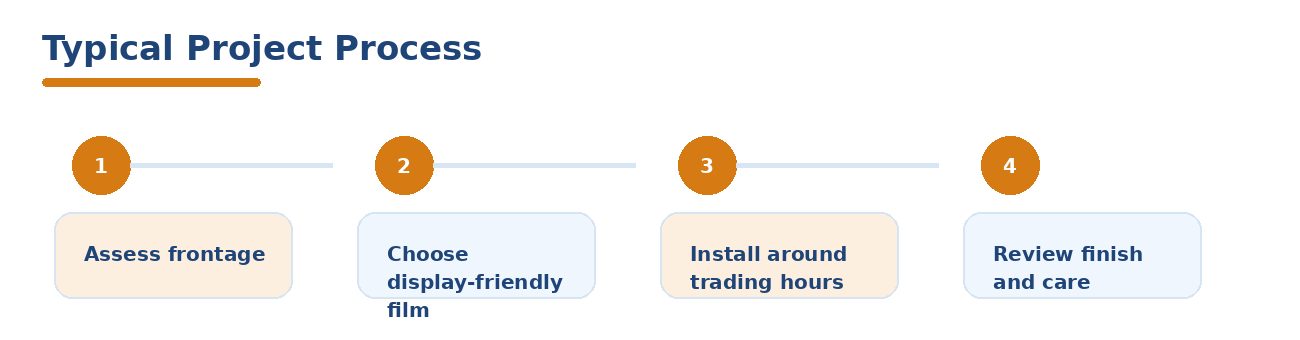
Retail businesses need installation to minimise disruption. Depending on the store, work can be planned before opening, after closing or by zone so that parts of the shop remain operational. The exact schedule depends on glass area, access, existing film and building restrictions.
The glazing is cleaned thoroughly before the film is applied, positioned and trimmed. Temporary moisture or haze can remain while the film cures. Displays and fixtures near the glass should be moved or protected to give installers safe access.
Shopping-mall retailers should also check building management procedures, access permits and working-hour restrictions before scheduling the project. External appearance rules may apply to some facades.
Retail Window Film Cost and Specification
Retail pricing depends on total glass area, chosen film, pane dimensions, access, existing film removal and site conditions. A large single-pane facade can differ in labour from a shopfront divided into many small sections. Night work or restricted access may also affect the installation plan.
Solar Heroes currently states that its solar films start from S$4.80 per square foot and carry a minimum five-year onsite warranty, subject to the selected product and applicable terms. For a commercial buyer, the quotation should identify the exact film model and specification so that performance, appearance and warranty can be compared properly.
A sample demonstration is often worthwhile before a full storefront installation because the business can assess both customer-side and street-side appearance.
Frequently Asked Questions
Will solar film hide my shop displays?
Not necessarily. Higher-VLT films can retain strong visibility through the storefront while adding solar-control performance.
Can window film reduce product fading?
It can reduce UV exposure and may reduce other solar factors, but fading can still occur from visible light, heat and material ageing.
Can film help customers feel cooler near the glass?
Reducing solar energy through the glazing can improve comfort near sun-exposed windows, although actual temperature changes depend on the building and operating conditions.
Is reflective film suitable for every storefront?
No. Reflectivity should suit the brand, building rules and desired visibility. Low-reflectivity ceramic or multilayer options may be preferable for an open look.
Can installation be done outside business hours?
Often yes, depending on building access and the size of the project.
Can film reduce glare on POS screens?
Yes. Lowering visible-light intensity can reduce glare, although screen positioning and local shading may also help.
Do mall stores need approval?
Building procedures vary. Retailers should check with mall or building management before making changes that affect the facade or require after-hours access.
What should I compare when selecting film?
Compare VLT, VLR and TSER, then review UV performance, appearance, warranty and glass compatibility.
A Practical Next Step
Retail window film should make the storefront work harder without making it look closed. Solar Heroes can assess the shop during the hours when heat or glare is most noticeable, compare suitable samples and recommend a film that protects visibility, customer comfort and brand appearance. For boutiques, showrooms, salons and glass-fronted stores, the best result comes from balancing commercial presentation with measurable solar-control performance.
Get a Window Film Recommendation
Contact Solar Heroes for a free consultation and onsite demonstration to compare suitable film options on your actual glass.
Request a Free Consultation