Nano Ceramic Window Film Installation in Singapore
Professional window film solutions and onsite product demonstrations for Singapore properties.
Request a Free Consultation
Nano ceramic window film has become a popular architectural option for homeowners and businesses that want solar control with low visible reflectivity and a relatively neutral appearance. Unlike traditional metallised films, ceramic films use non-metallic ceramic technology to manage solar energy while allowing manufacturers to produce films across a range of visible-light levels. For Singapore properties, that can be especially useful where heat and glare need to be reduced without creating a highly mirrored facade.
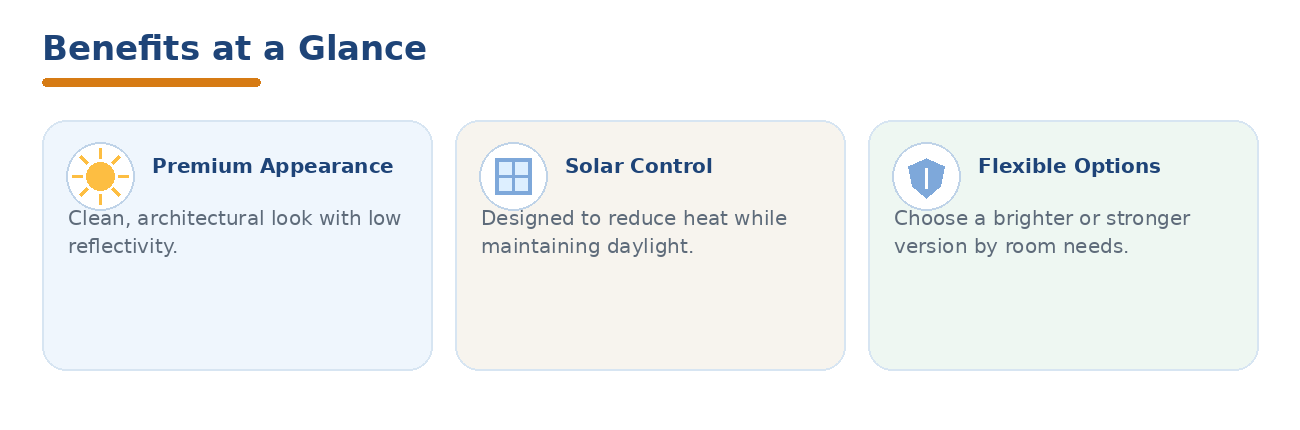
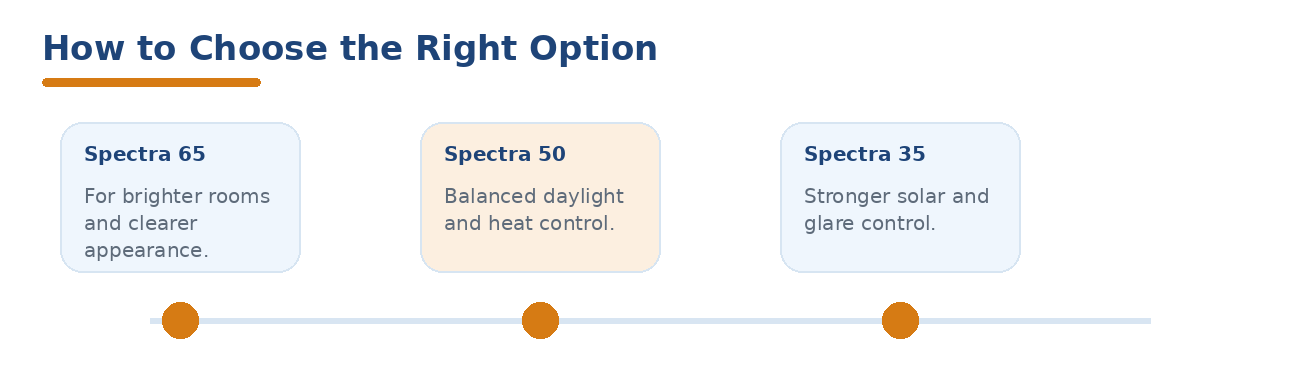
Solar Heroes currently offers the Spectra nano-ceramic range for architectural applications. Spectra 65, Spectra 50 and Spectra 35 provide different balances of daylight and solar control, allowing the film to be selected according to the room rather than treating 'ceramic' as a single performance level. Choosing the right ceramic film still requires careful comparison of Visible Light Transmittance (VLT), Visible Light Reflectance (VLR), Total Solar Energy Rejected (TSER), glass compatibility and the appearance of the sample on the actual window.
What Is Nano Ceramic Window Film?
Nano ceramic window film is an architectural film that incorporates ceramic materials rather than relying primarily on a metallic layer for its solar-control characteristics. The exact formulation varies by manufacturer, but the general appeal is the ability to provide solar performance with relatively low visible reflectivity.
The word 'nano' is widely used in film marketing, so buyers should look beyond the label. A ceramic film is not automatically high-performing simply because it uses ceramic technology. The measurable specifications of the exact model matter more: how much visible light passes through, how reflective the film is, and how much total solar energy is rejected.
For this reason, Solar Heroes' Spectra range is best compared model by model. Spectra 65 is intended for owners who want a brighter appearance, while Spectra 50 and Spectra 35 progressively reduce visible light and increase published TSER. This allows the technology to be matched to the severity of the sun exposure.
Ceramic Film vs Metallised Film
Metallised films use metal layers or particles to reflect part of the solar energy. They can provide effective solar control and may have a more reflective exterior appearance. Ceramic films use non-metallic ceramic materials and are often selected where lower reflectivity or a more neutral look is preferred.
Neither technology is automatically 'better' in every application. A reflective metallised film may suit a facade where strong daytime glare control and a more reflective appearance are acceptable. A ceramic film may suit a condo, landed home or office where the owner wants solar control with lower VLR.
The correct comparison should use the exact data. For example, Solar Heroes currently lists Ornyx Steel 30, a metallised option, with 33% VLT, 23% VLR and 57% TSER. Spectra 35 is listed with 37% VLT, 6% VLR and 60% TSER. Those figures show how two films with broadly similar visible-light levels can differ substantially in reflectivity and total solar rejection.
Spectra 65: Bright, Low-Reflectivity Solar Control
Spectra 65 is currently listed by Solar Heroes with 70% VLT, 7% VLR and 50% TSER. That makes it the brightest published option in the Spectra ceramic range and a candidate for rooms where the owner wants to retain substantial natural light.
A high-VLT film can be useful in living rooms, high-floor condominiums, offices and properties with attractive external views. It can also suit interiors that already have darker finishes and would feel gloomy with a strong tint. The trade-off is that a brighter film usually provides less visible-light reduction than a darker alternative, so it may not be sufficient for severe glare.
The best way to assess Spectra 65 is to place a sample on the actual window and view it from normal room positions. The change may appear subtle on a small piece but becomes easier to judge when compared directly with untreated glass.
Spectra 50: A Balanced Mid-Level Option
Spectra 50 is currently listed with 50% VLT, 7% VLR and 55% TSER. It sits between Spectra 65 and Spectra 35 in both visible-light transmission and overall solar-energy rejection. This makes it a useful option for customers who want more brightness control than Spectra 65 without choosing the darker Spectra 35.
For a typical living room, bedroom, office or study with moderate to strong solar exposure, this balance can be attractive. Because VLR remains low in the published data, the film can maintain a relatively low-reflectivity appearance compared with more mirror-like products.
A mid-level film is often the easiest place to start during a product demonstration because it helps the customer decide whether to move brighter or darker. The exact choice should still be based on orientation, glass area and how the room is used.
Spectra 35: Stronger Solar and Glare Control
Spectra 35 is currently listed with 37% VLT, 6% VLR and 60% TSER. It transmits less visible light than Spectra 50 or 65 and has the highest listed TSER among those three Spectra models. That can make it suitable for windows with stronger sun exposure or rooms where glare reduction is a higher priority.
A 37% VLT film will produce a more noticeable tint than a 70% VLT option, so the appearance should be tested on the actual glazing. In a bright west-facing room, that reduction may feel comfortable; in a shaded interior, it may feel darker than desired.
This illustrates why product selection should be room-specific. Ceramic technology gives the installer a family of options, but the owner's comfort depends on choosing the correct VLT and TSER for the specific window rather than selecting the same model across an entire property without assessment.
Representative Solar Heroes Film Comparison
| Film | Construction | VLT | VLR | TSER | Best-fit consideration |
|---|---|---|---|---|---|
| Spectra 65 | Nano ceramic | 70% | 7% | 50% | High daylight, low reflectivity |
| Spectra 50 | Nano ceramic | 50% | 7% | 55% | Balanced daylight and solar control |
| Spectra 35 | Nano ceramic | 37% | 6% | 60% | Stronger glare and solar control |
| P9970 | Multilayer polyester | 69% | 8% | 55% | Clearer architectural appearance |
| P9940 | Multilayer polyester | 41% | 8% | 62% | Stronger premium solar control |
Specifications shown are based on current Solar Heroes published service-page data and should be checked against the latest technical data sheet before quotation or publication.
Why TSER Matters More Than a Single IR Number
Infrared rejection is frequently highlighted in window film marketing, but IR figures can be measured over different wavelength ranges or at a single wavelength. Two products can therefore display impressive IR percentages that are not directly comparable.
TSER is generally more useful for comparing overall solar performance because it represents the total solar energy rejected by the film-and-glass system under the applicable test method. It accounts for the broader solar spectrum rather than only one infrared point.
This does not mean IR data has no value. It can provide supporting information when the test conditions are clear. The important point is that buyers should not choose a film based on an isolated 90% or 99% IR claim without understanding what was measured. VLT, VLR and TSER provide a more balanced starting point for architectural film selection.
Nano Ceramic Film for Homes and Condos
Ceramic film is attractive for residential properties because many owners want heat control without a highly mirrored exterior. In HDB flats, it can help manage bright living-room windows or west-facing bedrooms. In condominiums, low reflectivity can be valuable where the owner wants to preserve the external appearance and view, subject to the development's own MCST or facade rules.
Landed homes can use different Spectra levels on different elevations. A bright living room may use a higher-VLT ceramic film, while a strongly exposed upper bedroom may use a lower-VLT option. This allows the household to preserve daylight where it matters and strengthen control where sun exposure is more severe.
As with any film, glass compatibility should be checked before installation. Low-E, laminated and insulated glazing can require specific film placement or product approval.
Nano Ceramic Film for Offices and Commercial Spaces
Commercial spaces often value consistent daylight and a professional facade. Ceramic film can be useful in offices where employees experience glare and radiant heat near windows but the company does not want a strong mirror finish. It can also suit meeting rooms, reception areas and retail environments where exterior visibility and branding matter.
For larger projects, a pilot installation or sample demonstration can be particularly useful. Facility managers can observe the film over several days and assess employee comfort, screen visibility, room brightness and exterior appearance before approving an entire elevation.
Commercial selection should also consider building management requirements, cleaning practices, access and any existing glazing warranties. A technically strong film is only a good solution when it is compatible with the building and installation conditions.
Installation, Warranty and Maintenance
Professional nano-ceramic film installation starts with checking the glazing, measuring the panes and preparing the surface. The glass must be cleaned thoroughly because contamination under the film can remain visible. The film is then applied with installation solution, positioned, trimmed and squeegeed.
Temporary moisture or haze can be visible during curing. Owners should follow the installer's guidance before cleaning newly applied film. Once cured, use soft, non-abrasive materials and avoid blades or harsh pads.
Solar Heroes currently states that its solar films start from S$4.80 per square foot and carry a minimum five-year onsite warranty, subject to the specific product and warranty conditions. Customers should confirm the warranty applicable to the exact Spectra model chosen and retain the installation documentation for future reference.
Frequently Asked Questions
Is nano ceramic film completely clear?
No. Ceramic films are available at different visible-light levels. Some are relatively bright, while lower-VLT models have a more noticeable tint.
Does ceramic film contain metal?
Ceramic film is generally designed around non-metallic ceramic materials rather than a traditional metallised layer, although exact constructions vary by manufacturer.
Is ceramic film always better than metallised film?
No. The better choice depends on the desired reflectivity, daylight, solar performance, budget and building requirements.
Which Spectra film is brightest?
Based on Solar Heroes' current published figures, Spectra 65 is the brightest at 70% VLT.
Which Spectra option has the highest listed TSER?
Among Spectra 65, 50 and 35, Spectra 35 has the highest currently listed TSER at 60%.
Can ceramic film reduce glare?
Yes. Lower-VLT ceramic films reduce visible light and can therefore reduce glare, although the exact result depends on the room and screen positions.
Can it be installed on condo windows?
Often yes, subject to glass compatibility and any MCST or facade rules that apply to the development.
How should I compare ceramic films?
Compare VLT, VLR and TSER first, then consider appearance, UV performance, warranty, glass compatibility and the quality of installation.
A Practical Next Step
Nano ceramic window film is best understood as a technology choice, not a guarantee of one fixed result. Solar Heroes' Spectra range gives customers several levels of daylight and solar control, allowing the film to be matched to the room instead of selected by label alone. An onsite product demonstration can show how Spectra 65, Spectra 50 or Spectra 35 looks on the actual glass and help identify the best balance of brightness, glare reduction and total solar performance.
Get a Window Film Recommendation
Contact Solar Heroes for a free consultation and onsite demonstration to compare suitable film options on your actual glass.
Request a Free Consultation