
Landed Property Window Film Installation in Singapore
Professional window film solutions and onsite product demonstrations for Singapore properties.
Request a Free Consultation
Landed homes in Singapore can have very different solar-control needs from apartments. A terrace house may have a hot west-facing frontage, a semi-detached home can receive sun from multiple sides, and a bungalow may include double-height windows, skylight-adjacent glazing, stairwell glass and large sliding doors. Applying one film specification across every window can therefore be inefficient. Landed property window film works best when each elevation and room is considered as part of the whole house.
Solar Heroes supplies and installs architectural solar-control films for landed homes, with options that can reduce solar heat and glare while retaining the level of daylight and exterior view preferred by the household. Its range includes nano-carbon hybrid, metallised, nano-ceramic and multilayer polyester films, giving homeowners flexibility to choose different balances of brightness, reflectivity and total solar energy rejection. The objective is a practical comfort plan for the house, not simply a darker appearance on every pane.
Why Landed Homes Develop Uneven Heat Problems
Landed properties usually have more external wall and glass exposure than an apartment surrounded by neighbouring units. The front, rear and side elevations can receive sun at different times of day, while upper floors may be more exposed than ground-floor rooms shaded by landscaping or adjacent structures. Double-height spaces can also trap warm air and make solar gain from large panes more noticeable.
This creates a common pattern: one bedroom may be comfortable in the morning but hot after 3 p.m., while the dining area remains cool and a stairwell feels warm for most of the day. Treating every window with the same dark film can overcorrect some spaces and still fail to address others optimally.
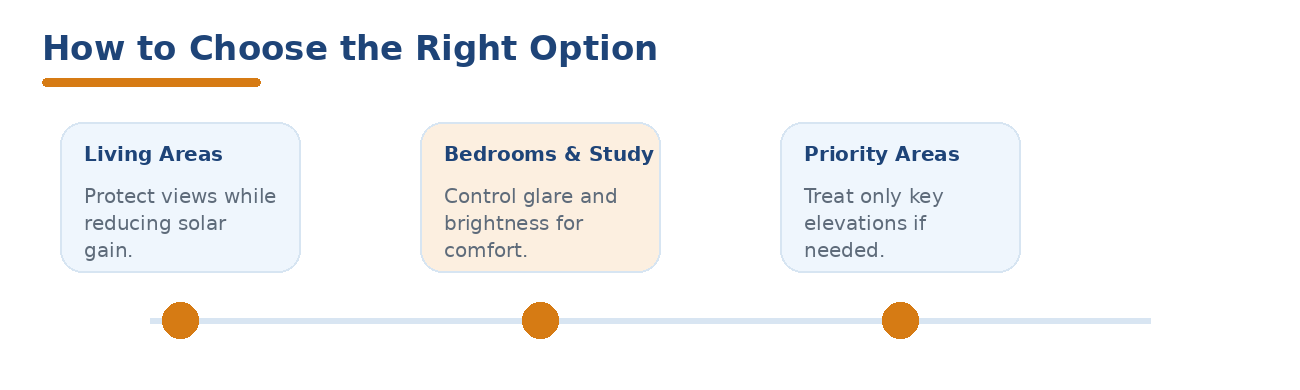
A better process maps the sun exposure of the property. The installer identifies the panes receiving direct sun, the rooms where occupants feel discomfort, the areas where glare matters and the spaces where a bright open appearance is most important. That information guides a room-by-room film specification.
Whole-House Installation vs Priority-Area Installation
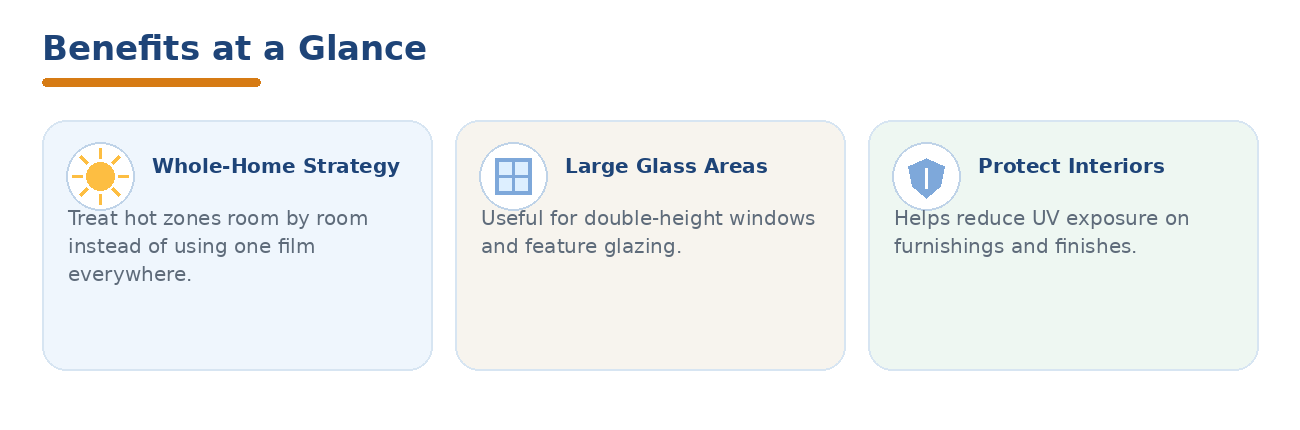
A whole-house film installation can create a consistent appearance and may be appropriate when most elevations receive significant sun. It is not always necessary, however. Some landed homeowners achieve better value by treating a west-facing facade, the upper-storey bedrooms and the double-height living area first.
Priority-area installation is especially useful when the household is unsure how much tint it wants. The hottest rooms can be treated with a suitable film, allowing the owners to live with the result before extending the solution elsewhere. On the other hand, a coordinated whole-house plan may use different VLT levels while keeping the external appearance reasonably consistent.
The decision should therefore be based on the building, not on a generic package. A site survey can help distinguish windows that contribute meaningfully to solar heat from those that are mostly shaded by overhangs, trees, neighbouring structures or orientation.
Window Film for Large and Full-Height Glass
Large glazed doors and full-height windows make homes feel connected to gardens, patios and outdoor areas, but they can also create strong solar exposure. The main challenge is preserving the view while reducing enough solar energy to improve comfort.
Higher-VLT, low-reflectivity films can be useful where maintaining a bright, premium appearance matters. Solar Heroes currently lists Spectra 65 at 70% VLT, 7% VLR and 50% TSER, and P9970 at 69% VLT, 8% VLR and 55% TSER. Where stronger solar control is required, lower-VLT options such as Spectra 35 or P9940 can be evaluated.
Large panes also make installation quality more visible. Clean preparation, accurate trimming and careful removal of installation solution are essential. The glazing type should be confirmed before installation, especially for laminated, insulated or Low-E glass, because not every film is suitable for every construction.
Double-Height Living Rooms and Stairwells
Double-volume spaces can be visually impressive but challenging to cool. Tall glazing may admit solar energy over a large area, while warm air rises and accumulates at upper levels. Window film cannot change the physics of air stratification, but reducing solar gain through the glass can address one significant source of heat.
Access is another consideration. High panes may require ladders, towers or other safe access equipment, so the installer needs to assess the site before quoting. Built-in features, voids and staircases can make installation more complex than the same square footage at standard height.
For double-height areas, homeowners should compare film samples from the normal viewing distance as well as close to the glass. A subtle difference in reflectivity can become more noticeable across a large architectural feature, and the chosen film should complement the home's interior design rather than dominate it.
Bedrooms, Family Areas and Home Offices
Landed homes often have bedrooms facing different directions, which makes a single tint level unnecessary. A west-facing master bedroom may need stronger glare and solar control, while a shaded child's room may benefit from a brighter film. Family rooms and studies may need additional glare reduction for screens.
A film recommendation should consider how long the room is occupied and at what time. A guest room that is rarely used in the afternoon may not need the same treatment as a home office occupied during peak sunlight. Likewise, a bedroom used for daytime rest may prioritise lower visible light more than a living room designed around a garden view.
This is where multiple film technologies are useful. Rather than treating technology names as marketing labels, the installer can use the relevant VLT, VLR and TSER figures to select a measurable performance range for each room.
Representative Solar Heroes Film Comparison
| Film | Construction | VLT | VLR | TSER | Best-fit consideration |
|---|---|---|---|---|---|
| Spectra 65 | Nano ceramic | 70% | 7% | 50% | High daylight, low reflectivity |
| Spectra 50 | Nano ceramic | 50% | 7% | 55% | Balanced daylight and solar control |
| Spectra 35 | Nano ceramic | 37% | 6% | 60% | Stronger glare and solar control |
| P9970 | Multilayer polyester | 69% | 8% | 55% | Clearer architectural appearance |
| P9940 | Multilayer polyester | 41% | 8% | 62% | Stronger premium solar control |
Specifications shown are based on current Solar Heroes published service-page data and should be checked against the latest technical data sheet before quotation or publication.
Protecting Interior Finishes from Sun Exposure
Ultraviolet radiation contributes to fading, but it is not the only cause. Visible light, heat, material chemistry and exposure time also influence how floors, artwork, fabrics, leather and timber change over time. Window film that reduces UV transmission can therefore help reduce one important contributor to fading, but it should not be marketed as a guarantee that furnishings will never fade.
Solar Heroes currently publishes 99.9% ultraviolet rejection for multiple films in its range. That performance should be confirmed against the current technical data for the exact film selected. Owners with valuable artwork, antiques or light-sensitive materials may still need additional conservation measures such as curtains, controlled lighting or specialist display protection.
The practical benefit for most homes is that solar-control film can combine UV reduction with heat and glare management in one window treatment, helping protect both comfort and interior finishes.
Choosing Film by TSER, VLT and VLR
For a landed house, the three most useful comparison measures are VLT, VLR and TSER. VLT indicates how much visible light passes through, VLR indicates visible reflectivity and TSER indicates overall solar energy rejection under the applicable test conditions.
A homeowner wanting bright rooms should normally start with higher VLT options and then compare their TSER. A homeowner primarily concerned with severe glare may accept a lower VLT. Someone seeking a more reflective facade may consider a metallised film, while an owner wanting low reflectivity may prefer ceramic or multilayer alternatives.
Infrared rejection figures can provide additional information, but they should be interpreted carefully because test wavelengths and methods can differ. An IR percentage should not replace TSER when comparing total solar performance. The most reliable decision combines technical data, a real sample on the glass and a clear understanding of the room's purpose.
Installation Planning for Larger Homes
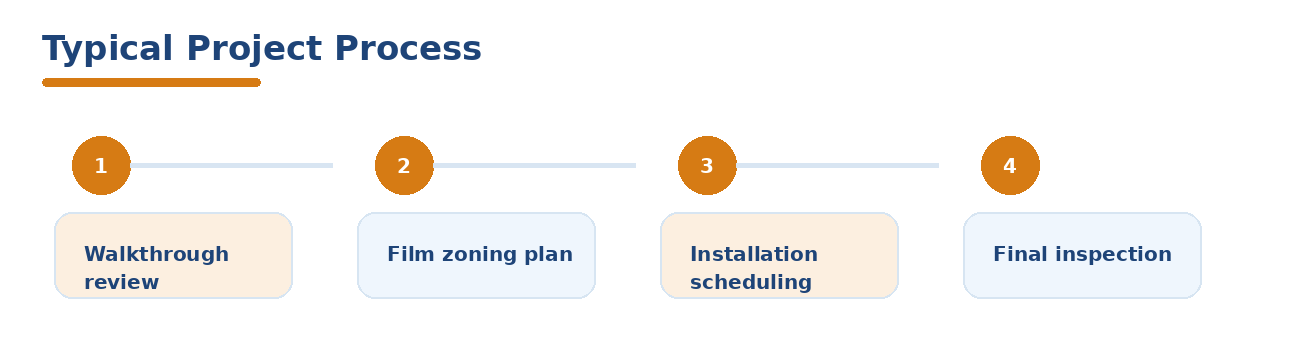
Landed-property installations benefit from planning because access, furniture, curtains, tall glazing and multiple floors can affect the work sequence. Before installation, the windows should be accessible and fragile items near the work area should be moved. The installer may need extra time for high or awkward panes.
The glass is cleaned carefully before film application. Once fitted, the film may show temporary moisture or haze while curing. Owners should follow the installer's advice about when the film can be cleaned and should use soft, non-abrasive materials afterwards.
For larger projects, homeowners may also want the film schedule documented by room or elevation. Recording which film was installed on each window makes future replacement, renovation or extension work much easier and helps maintain a consistent appearance over time.
Cost Factors and Long-Term Value
Landed-home quotations are affected by the total glass area, selected film, pane size, height, access, old film removal and complexity. A house with many small panes can require more labour than a property with the same total area in a few large panels. High-level access can also affect pricing.
Solar Heroes currently states that solar films start from S$4.80 per square foot and include a minimum five-year onsite warranty, subject to the applicable product and warranty terms. Price should still be evaluated alongside the exact film model, technical performance, suitability for the glazing and installation quality.
The most cost-effective project is not necessarily the lowest square-foot rate. It is the project that treats the right windows with the right film, preserves the home's design goals and avoids paying to darken shaded areas that were never causing a problem.
Frequently Asked Questions
Should every window in a landed house use the same film?
No. Different elevations and rooms often have different sun exposure, views and brightness requirements.
Can window film be used on double-height windows?
Often yes, provided the glass is compatible and the installer can access the panes safely.
Will solar film protect furniture from fading?
It can reduce UV exposure and may reduce other solar factors depending on the film, but fading can still occur from visible light, heat and material ageing.
Is ceramic film always best for landed homes?
Not automatically. Ceramic, metallised, hybrid and multilayer films each have different performance and appearance characteristics. The exact film should be matched to the room.
Can I treat only the west-facing side of the house?
Yes. A targeted installation can be practical if that elevation is the main source of heat and glare.
How do I keep rooms bright after filming?
Start with higher-VLT options and compare their TSER and reflectivity on the actual glass.
Can film go on Low-E or laminated glass?
Sometimes, but the glass construction and film compatibility must be assessed before installation.
How long does installation take?
It depends on glass area, access and complexity. A site survey is the best way to estimate the schedule for a landed property.
A Practical Next Step
Every landed home has its own solar pattern. Solar Heroes can assess the property by room and elevation, demonstrate film samples and build a practical plan for the windows that actually need treatment. Whether the priority is a hot west-facing bedroom, a double-height living room, a home office or a full-property installation, selecting film from real performance data and real site conditions produces a more useful result than applying one tint everywhere.
Get a Window Film Recommendation
Contact Solar Heroes for a free consultation and onsite demonstration to compare suitable film options on your actual glass.
Request a Free Consultation