
Condo Window Film Installation in Singapore
Professional window film solutions and onsite product demonstrations for Singapore properties.
Request a Free Consultation
Condominium homes in Singapore often feature large panes, balcony doors and full-height glazing designed to maximise daylight and views. Those architectural advantages can also create intense afternoon heat, screen glare and uneven room temperatures, especially in high-floor or west-facing units. Condo window film provides a way to improve the performance of existing glass while preserving the openness that makes a glazed apartment attractive.
Solar Heroes supplies and installs solar-control window films for condominium homes, with solutions chosen according to orientation, glass construction, desired brightness, reflectivity, privacy and the visual requirements of the development. Condo projects benefit from a more considered approach than simply choosing a dark tint because the view, facade appearance and building management rules can matter as much as heat reduction. The best result is a film that improves indoor comfort while still looking appropriate from both inside and outside the unit.
Why Condo Glazing Needs a Different Approach
Condominiums frequently use larger expanses of glass than older apartments or HDB flats. Floor-to-ceiling windows can admit significant solar energy because there is simply more exposed glazing. The problem can be particularly noticeable in living rooms connected to balconies, corner units with two exposed elevations and bedrooms that receive low-angle afternoon sun.
A larger glass area also makes visual changes more obvious. A film that looks only slightly darker on a small sample can have a more dramatic effect across an entire wall of glass. Reflectivity can also influence the external appearance of the unit. For that reason, condo owners should compare samples at useful scale and review the building's applicable renovation or facade rules before selecting a highly reflective or visibly darker product.
The objective is to identify where the discomfort comes from. If heat and glare are concentrated on one elevation, treating the problem-facing windows may be more effective than applying the same film throughout the whole apartment.
Preserving a City, Sea or Garden View
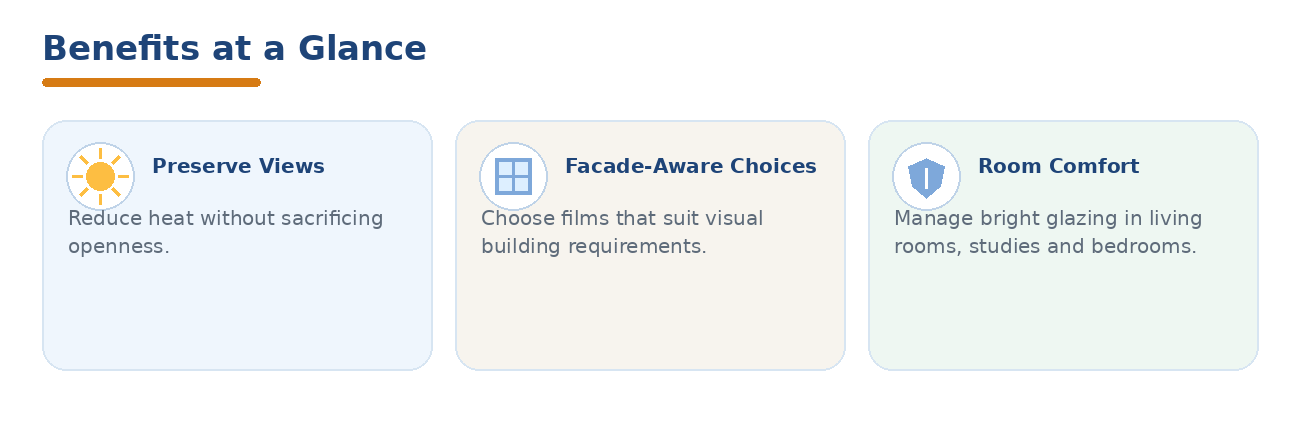
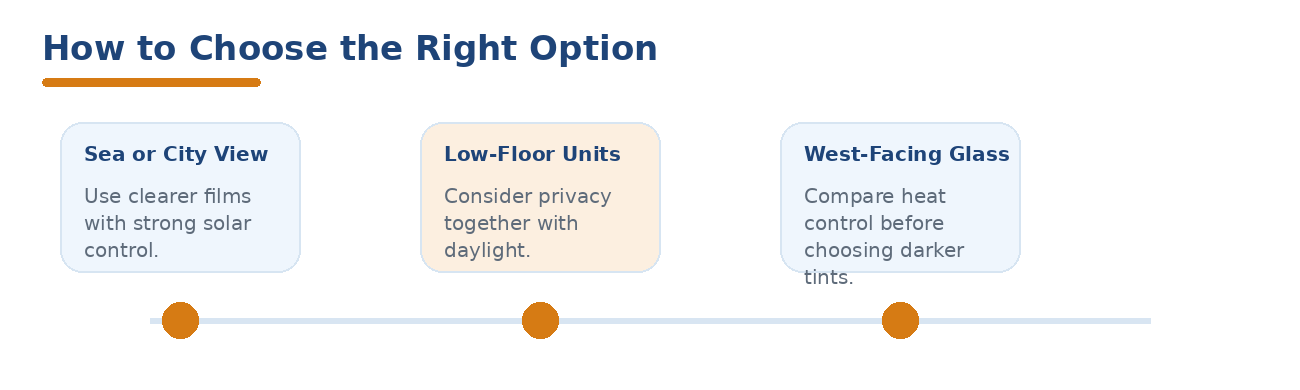
Many condo owners hesitate to install film because they do not want to lose a view they paid for. Fortunately, solar control does not always require a dark, mirror-like finish. High-VLT, low-reflectivity films can retain a much clearer visual connection to the outdoors while still reducing part of the solar energy passing through the glass.
Solar Heroes' Spectra 65 is currently listed with 70% visible light transmittance, 7% visible light reflectance and 50% TSER. P9970 is listed with 69% VLT, 8% VLR and 55% TSER. These are examples of brighter options for owners who prioritise clarity and daylight. Where stronger solar control or glare reduction is needed, lower-VLT options such as Spectra 35 or P9940 can be considered, subject to glass compatibility and appearance preferences.
The key is to view samples on the actual window during the hours when the problem occurs. A film can look different in the morning, during bright afternoon sun and at night under indoor lighting.
West-Facing Condo Units and Afternoon Heat
A west-facing condo can become noticeably hotter from mid-afternoon into the evening. Low-angle sunlight may penetrate deep into living rooms and bedrooms, warming flooring, furniture and interior surfaces. Air-conditioning can remove heat from the air, but occupants may still feel radiant warmth near the glass.
For these units, TSER should be one of the central comparison metrics because it describes overall solar energy rejection rather than focusing on one narrow part of the solar spectrum. Lower VLT can also reduce glare, but the darkest film is not always necessary if the owner wants a bright interior.
An installer can also recommend different films by elevation. A west-facing living room may use a stronger solar-control option, while a shaded north- or south-facing room may use a clearer film or no film at all. This selective strategy can preserve daylight where it is valuable while solving the windows that are actually causing discomfort.
Condo Bedrooms, Studies and Home Offices
Bedrooms and workspaces often have different priorities from living areas. In a bedroom, lower brightness may be welcome, particularly when the windows receive strong late-day sun. In a study or home office, the main issue may be reflected glare on a monitor rather than temperature alone.
Anti-glare performance is closely related to visible light control and room layout. A film can reduce the intensity of daylight entering the room, but it cannot correct every glare problem if a screen is placed directly opposite a bright window. Combining film with thoughtful screen positioning, blinds or curtains may produce a better result than relying on film alone.
For work-from-home spaces, the goal should be comfortable visual contrast. A film that is too dark can make the room depend on artificial lighting throughout the day, while a film that is too light may not reduce glare enough. Comparing multiple VLT levels on the actual glass is the most practical way to find the balance.
Privacy for Low-Floor and Overlooking Units
Condo privacy concerns vary widely. Ground-floor units, apartments facing common corridors and closely spaced developments may have direct sightlines that upper-floor units do not. Tinted or reflective solar films can reduce visibility from the brighter side in daytime, but they should not be sold as permanent one-way privacy.
When the interior is brighter than the exterior at night, reflective privacy can weaken or reverse. Owners who need dependable night privacy should continue using curtains or blinds. Where a clear outward view is not important, frosted film can provide stronger visual obscurity for selected panes, bathrooms or glass partitions.
A good condo film plan therefore separates solar-control needs from privacy needs. The same product may help with both in some rooms, but privacy expectations should be discussed explicitly before installation so the owner understands how lighting conditions affect the result.
Representative Solar Heroes Film Comparison
| Film | Construction | VLT | VLR | TSER | Best-fit consideration |
|---|---|---|---|---|---|
| Spectra 65 | Nano ceramic | 70% | 7% | 50% | High daylight, low reflectivity |
| Spectra 50 | Nano ceramic | 50% | 7% | 55% | Balanced daylight and solar control |
| Spectra 35 | Nano ceramic | 37% | 6% | 60% | Stronger glare and solar control |
| P9970 | Multilayer polyester | 69% | 8% | 55% | Clearer architectural appearance |
| P9940 | Multilayer polyester | 41% | 8% | 62% | Stronger premium solar control |
Specifications shown are based on current Solar Heroes published service-page data and should be checked against the latest technical data sheet before quotation or publication.
MCST and Facade Considerations
Condominiums are managed developments, and owners should check their own MCST, renovation handbook or managing agent requirements before installing films that materially change the external appearance of the glazing. Rules vary by development, so there is no universal statement that every reflective or tinted film is automatically allowed or prohibited.
This is particularly important for highly reflective films, darker films or installations that create visible inconsistency across a facade. A low-reflectivity, neutral-looking film may be more suitable where exterior uniformity is a priority, but the final choice should still comply with the specific development's rules.
If approval or notification is required, it is useful to have the film name, appearance, VLT/VLR data and any available product documentation ready. Owners should obtain the necessary confirmation before installation rather than assuming a sample that looks acceptable from inside will meet all building requirements.
Choosing Between Ceramic, Metallised, Hybrid and Multilayer Films
Different film constructions can suit different condo priorities. Nano-ceramic films are often selected for low reflectivity and strong solar control while maintaining a more neutral appearance. Metallised films can provide effective solar control with a more reflective look, which may be desirable in some applications and less suitable in others. Hybrid films combine technologies to balance performance and appearance. Multilayer optical or polyester films can provide high solar rejection with relatively clear, low-reflectivity aesthetics.
Solar Heroes currently offers Black Pearl nano-carbon hybrid, Ornyx metallised, Spectra nano-ceramic and P99 multilayer polyester ranges. Rather than treating one technology as automatically superior, owners should compare the exact model's tested figures and the way it looks on their glass.
Film-to-glass compatibility also matters. Specialised glazing such as Low-E, laminated or insulated units should be assessed before installation because film placement and solar absorption can affect thermal stress.
Installation, Curing and Care
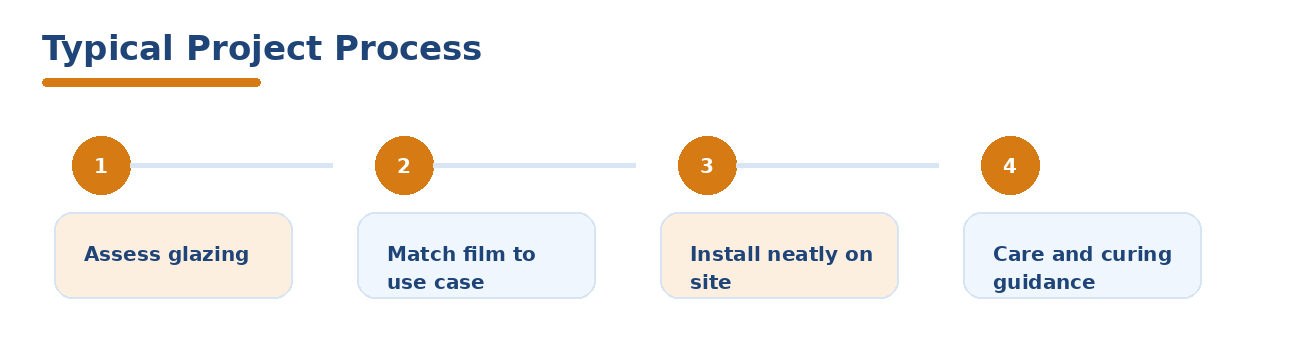
Professional installation begins with glass inspection, measurement and careful cleaning. The film is fitted to the interior or specified surface of the glass according to the product and glazing requirements, then trimmed and squeegeed to remove installation solution. Large condo panes require careful handling to maintain clean edges and consistent appearance.
A newly installed film can show temporary haze or small moisture pockets while it cures. Curing time varies with film, weather, glass and exposure. Owners should wait until the installer confirms that the film has cured sufficiently before cleaning it.
Use soft cloths or non-abrasive tools and suitable glass cleaners. Avoid blades and abrasive pads. If the unit has automated blinds, window sensors or specialised window hardware, mention them during the site survey so the installation can be planned around them.
Condo Window Film Pricing and Value
The cost of a condo project depends on the total glass area, chosen film, size of panes, access, height, existing film removal and installation complexity. Full-height windows can involve more film and more handling than standard panes. Access near balconies, built-in cabinetry or fixed screens can also affect labour.
Solar Heroes currently states that its solar films start from S$4.80 per square foot with a minimum five-year onsite warranty, subject to the relevant film and warranty terms. Owners comparing quotations should check that they are comparing the same film specification and scope, not simply the headline square-foot rate.
The highest-value installation is one that solves the actual problem without unnecessarily treating every window. A site survey can determine whether the best plan is one hot elevation, selected rooms or the entire unit.
Frequently Asked Questions
Will condo window film spoil my view?
It does not have to. Higher-VLT, low-reflectivity films are designed to preserve more daylight and a clearer outward view.
Do I need MCST approval?
Requirements vary by development. Check your MCST, managing agent or renovation rules, especially for films that noticeably change facade colour or reflectivity.
Is the darkest film always the best for a west-facing unit?
No. Darker films reduce visible light and glare, but the best choice balances TSER, VLT, appearance and your preference for daylight.
Can film be installed on floor-to-ceiling glass?
Often yes, provided the film is compatible with the glass and the installation can be accessed safely.
Does reflective film give night privacy?
Not reliably. The privacy effect depends on which side is brighter and can reverse at night.
Can different rooms use different films?
Yes. Different orientations and room uses often justify different film specifications.
What should I compare on a technical sheet?
Start with VLT, VLR and TSER, then review UV performance, warranty, construction and glass compatibility.
Can solar film reduce air-conditioning use?
Reducing solar heat through glass can lower the cooling load, but actual energy savings depend on many factors such as glass area, orientation, thermostat settings, occupancy and building efficiency.
A Practical Next Step
Condo window film should protect what owners value about the apartment: natural light, views and a clean architectural appearance. Solar Heroes can compare suitable film samples on the actual glazing, assess the problem windows and recommend options based on heat, glare, privacy and facade considerations. For a high-floor, west-facing or heavily glazed unit, a targeted onsite assessment can make the difference between simply darkening the glass and achieving a genuinely more comfortable home.
Get a Window Film Recommendation
Contact Solar Heroes for a free consultation and onsite demonstration to compare suitable film options on your actual glass.
Request a Free Consultation